
You can handle one rejection. After several, the questions become harder to ignore. Am I applying at the wrong level? Is my private-sector experience not valued? Did a computer reject the application? Do I need to use the capability wording exactly?
The frustrating part is that a rejection email rarely gives you enough information to know. It tells you the outcome, not necessarily the cause.
I would be careful about anyone offering one universal explanation. Some applications target the wrong roles. Some leave good evidence unclear. Some compete against stronger matches. Some involve requirements the applicant has not recognised. Without the application, the vacancy and meaningful feedback, certainty would be misplaced.
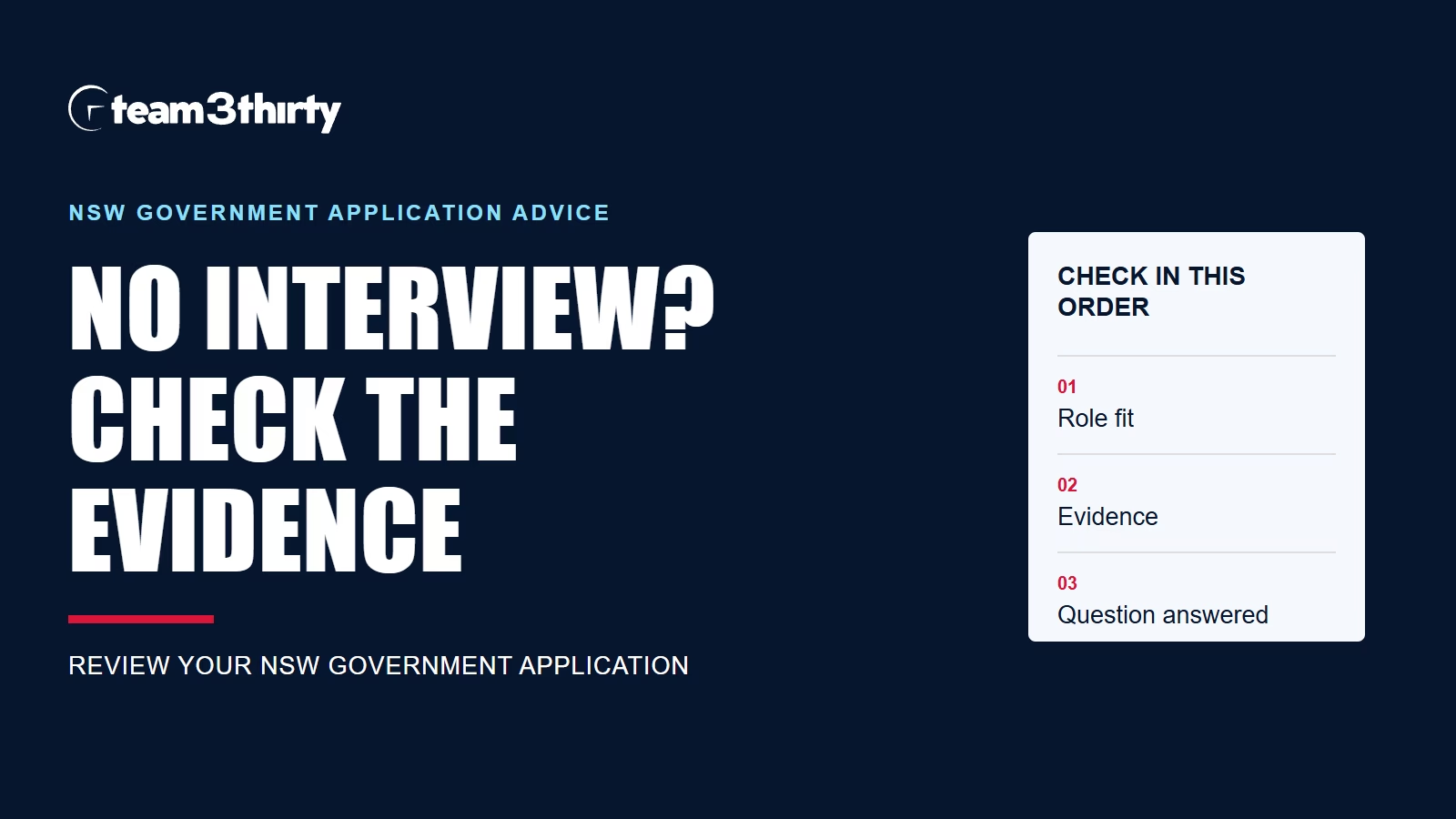
What you can do is review the process in a useful order. Start with fit, move to evidence and only then concentrate on wording. Otherwise, you risk becoming very good at editing an application that is still answering the wrong brief.
First, identify where the process is stopping
Not getting interviews is different from getting interviews but not offers. The first points your review towards role selection and the material used for initial assessment. The second may require attention to interviews, work tasks, references or the overall match.
That does not provide a diagnosis by itself. It gives you a more useful place to look.
I would take a small sample of recent applications and compare them with their job information. Were they similar roles at similar levels? Did you meet the essential requirements? Were you using substantially the same examples? Did you receive any specific feedback? Look for a pattern before drawing a conclusion from one outcome.
A run of rejections gives you a reason to review the pattern. Compare the role requirements with the evidence you submitted before deciding what to change.
Check the role before blaming the writing
A role may suit your interests without matching your current evidence. A familiar title or attractive salary does not establish fit.
Read the purpose, accountabilities, challenges and essential requirements. Then look at the capabilities and levels. The recruitment guidance considers relevant knowledge and experience alongside capability; a well-written response does not replace an essential qualification or specialist requirement. [1]
Be especially cautious with grade assumptions. A private-sector title does not convert automatically into a NSW grade, and a grade does not map to one universal capability level. [2] Use the actual focus capabilities and levels in the role description to test your examples.
Sometimes the right response is to improve the application. Sometimes it is to pursue a different role family, grade or entry point. Making that distinction can save considerable effort.
Your experience may be relevant but invisible
An application can contain impressive organisations, long tenure and substantial responsibilities without showing enough about your own contribution.
An illustrative CV might say “managed reporting, stakeholders and continuous improvement”. The candidate may have excellent evidence underneath that sentence, but the reader cannot see it. What reporting? Which decisions did it support? What problem did the candidate improve?
For illustration, compare it with: “I checked the source records behind the monthly report, found that two teams were using different definitions and worked with both managers to agree one reporting rule.” This is a constructed example, not a client result. It makes the action and contribution visible; the real applicant would still need to explain the outcome using verified facts.
The official guide asks reviewers to consider evidence in the resume and application against the role requirements. It does not assume the panel already knows what a candidate’s job title means. [1]
Explain the work so someone outside your organisation can follow it. You do not need to include every detail. You do need to remove the need for the reader to guess.
You may be describing the right capability at the wrong scope
A candidate can provide a genuine example of problem-solving that is too narrow for a particular role. That does not make the example bad. It makes the match uncertain.
For an illustrative senior role, resolving a straightforward error through a known procedure may not demonstrate the broader analysis or judgement being sought. A different example might be more suitable. Alternatively, the original example may have involved much more complexity than the draft reveals.
Look at the decisions in your answer. What was uncertain? What could you decide? What required approval? Who depended on your work? What alternatives did you consider?
Adding words such as strategic and complex will not solve a scope problem. The details need to support the claim.
The answer may not address the question asked
This happens when an applicant chooses a favourite example before reading the question carefully. The story is strong, but the connection is incomplete.
An illustrative question asks how you analysed information and influenced a decision. The response explains an analysis in detail but never says who needed to be persuaded or what changed in the decision. Another question asks about adapting when priorities changed; the response describes a project that ran smoothly from start to finish.
The application may be well written and still leave the requested evidence missing.
Underline the verbs in the question. Describe, explain, analyse, influence, adapt, evaluate. Then check that your answer actually does those things. If the question has two parts, make sure both receive substantive attention.
Generic writing makes genuine experience harder to assess
“I am a highly motivated professional with exceptional communication skills” could belong to almost anyone. It uses space without helping the reader understand your fit.
Specific writing does not need to be elaborate. Explain the context, your responsibility, what you did and the outcome. The official Capability Application Tool recommends concrete examples and clear identification of your own actions. [3] Our government resume examples show how that evidence can appear on the page.
AI-assisted drafting can be useful for some writing tasks, but a polished generic answer remains generic. Do not let a tool invent actions, metrics or a level of responsibility you did not have. And follow any instructions governing assistance in the recruitment process.
The practical test is whether you can explain every claim naturally at interview. If a sentence sounds impressive but you would struggle to say what actually happened, it needs work.
Do not assume the explanation is an ATS
A rejection email does not tell you whether an automated screen, an essential requirement or a comparison with other candidates affected the decision. The official recruitment guide describes reviewing applications against role requirements. [1] That gives you a useful basis for improving your next submission without guessing how a particular agency’s software works.
Use accurate, relevant language. Make qualifications and essential requirements easy to identify. Follow the instructions and answer the questions. Those actions are more defensible than keyword stuffing based on an unverified theory.
Competition remains a possible explanation
An application can be credible and still not be selected. Recruitment is not an agreement that every person who could do the job will receive an interview.
Without information about the field and the decision, you should not assume that a rejection proves a major defect in your application. Equally, competition should not become a reason to avoid reviewing anything you can improve.
Ask for feedback where available. A useful question is which requirements were not demonstrated strongly enough, rather than whether the reader generally liked your CV. Specific feedback can help distinguish a role-fit issue from an evidence issue.
Where feedback is unavailable, make the limits of your own review clear. You can assess whether an application addresses the vacancy; you cannot reconstruct a panel’s private reasoning with certainty.
What I would change before sending the next one
I would choose one role that appears genuinely suitable and review it carefully. I would identify the essential requirements, the focus capabilities and levels, and the exact submission instructions. Then I would select examples that make a credible case for those requirements.
I would remove unsupported claims and recover the decisions hidden inside generic descriptions. I would check that the CV and written answers reinforce each other without unnecessary repetition. Finally, I would review the complete application against the actual questions and limits.
That process will not promise an interview. It will give you a clearer basis for the next application than changing a few adjectives and hoping the result is different.
For your next application, put the vacancy and your draft side by side. Mark the evidence for each essential requirement and each part of the question. Any blank or vague section gives you a specific task to fix.
If you have chosen a suitable role and want help preparing its written documents, request a Complete Government Application. We start with the vacancy and your experience, then build the evidence into the documents it asks for.