
“Tell me about yourself” is an invitation to give the interviewer a useful introduction to your professional experience. Start with the work or study most relevant to the role, identify one or two strengths you can support, and explain why this position is a sensible next step. You do not need to retell your life story or recite every line of your resume.
For a government interview, keep the introduction connected to the advertised work. The panel may use a different opening question or move straight into assessment questions, so prepare this as a flexible introduction rather than a speech you must deliver.
What should your answer include?
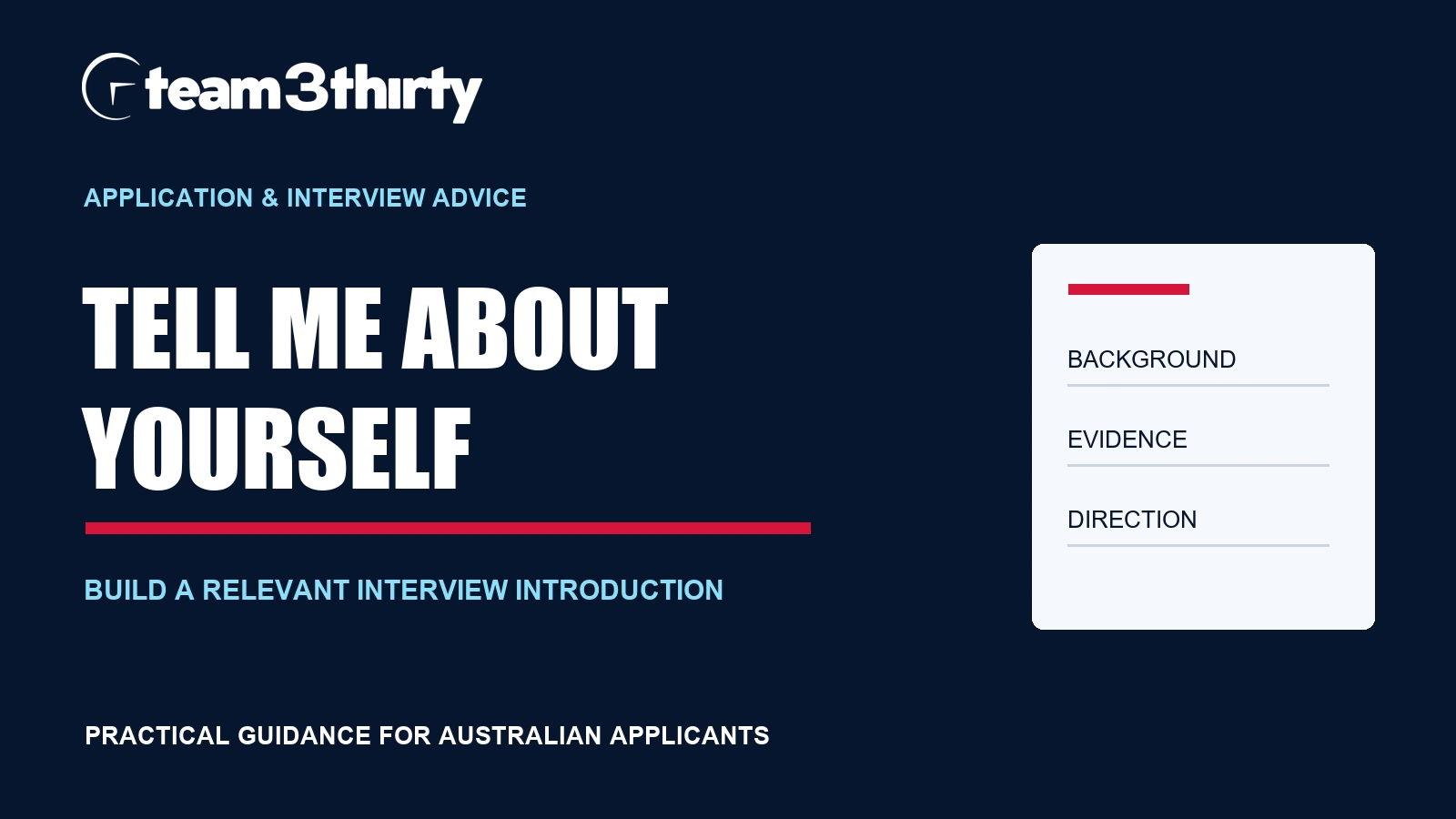
A useful introduction answers three practical questions: what relevant experience you bring, what that experience has prepared you to do, and why you are interested in this role. Start with the strongest connection. If you are changing careers, that connection may be a type of work you have performed rather than your current job title.
As a rehearsal aid, aim for an answer you can deliver comfortably in about a minute, then adjust to the invitation and panel’s guidance. That is not an official timing rule. The point is to leave room for the interview itself while giving the listener enough context to understand your background.
- Current position: a brief description of relevant work, study or experience.
- Useful evidence: one or two activities or strengths connected to the advertised duties.
- Direction: why you want to bring that experience to this position.
Example for an experienced administration applicant
Fictional example: “I have worked in administration and service support for the past six years, most recently coordinating records and enquiries for a busy operational team. Much of my work involves checking information, keeping requests moving and making sure colleagues know what needs a decision. I have also helped improve our handover notes so outstanding matters are easier to pick up. This role interests me because it combines that practical coordination work with support for a public-facing service. I would bring experience working through competing requests and communicating clearly with the people involved.”
This answer introduces a direction and a few relevant activities. It does not attempt a complete STAR example. If the panel asks about the handover improvement, the applicant needs to explain what they changed and what happened, using their actual experience.
Example for a career changer moving into government
Fictional example: “My background is in retail operations, where I have supervised shifts, handled escalated customer enquiries and coordinated work during busy periods. The part I have enjoyed most is resolving issues by understanding what happened, explaining the available options and following through on the next step. I am now looking to apply those skills in a government service role. This position appeals to me because it involves clear processes and careful communication with people who need useful information. I would be bringing practical customer experience while learning the agency’s systems and responsibilities.”
The answer makes a credible connection without pretending the applicant already understands every government process. Identify the actual duties that transfer to your target role. If an essential qualification or registration is required, transferable experience does not replace it.
Example for a graduate with limited professional experience
Fictional example: “I recently completed a degree in business and have been working part-time in customer service while studying. In my final-year project, I helped a small team organise its research, compare options and prepare a recommendation. That gave me practice bringing information together and explaining why we had chosen a particular approach. I am interested in this role because it offers the chance to develop those skills in practical program support. I would bring a willingness to learn, experience managing study and work commitments, and examples of following a shared task through to completion.”
A graduate can use study, casual work or volunteering when it is relevant and described accurately. Avoid replacing evidence with a list of adjectives. “Motivated and hardworking” becomes more useful when the interview later explores the commitments you managed and the actions you took.
Adapt the introduction to the actual vacancy
Read the role description and underline the two or three duties that best connect to your background. Then remove material from the introduction that does not help explain that connection. A project-support role may call for coordination and tracking; a service role may call for enquiries and accurate records. Your introduction should reflect the position in front of you.
Keep your level of responsibility accurate. If you supported a project manager, say that and explain the work you owned. Changing “supported the project” into “led the project” makes the introduction stronger only on the surface; it creates a claim you must then defend.
Common mistakes in “tell me about yourself” answers
The first is beginning too far back. A chronological account of school, every job and every reason for leaving can use up the opening without explaining why the applicant fits. Start where the relevant evidence starts.
The second is copying a sample word for word. The fictional answers here show shape and emphasis; their facts belong to invented applicants. Replace them with your own work and language. The third is giving unsupported promises about what you will achieve before you understand the role’s authority and constraints.
It is also easy to confuse the introduction with a behavioural answer. For a question asking what you did in a particular situation, use a specific example instead. Our STAR method guide explains that structure, and the government interview questions guide helps you prepare for different question types.
Rehearse from three notes
Write three prompts: relevant background, useful evidence and reason for this role. Practise speaking from those prompts, then try a second version without keeping the wording identical. This helps you retain the main point while listening to how the question is actually asked.
Check that you can expand each claim with a truthful example. If a phrase only sounds impressive, either substantiate it or remove it. Your introduction should open a conversation you are ready to have.
Queensland Government’s interview guidance recommends researching the employer and preparing relevant achievement scenarios. Use those basics alongside the specific invitation. For a confirmed government interview, see the Interview Preparation Pack for the current role-specific preparation option.