
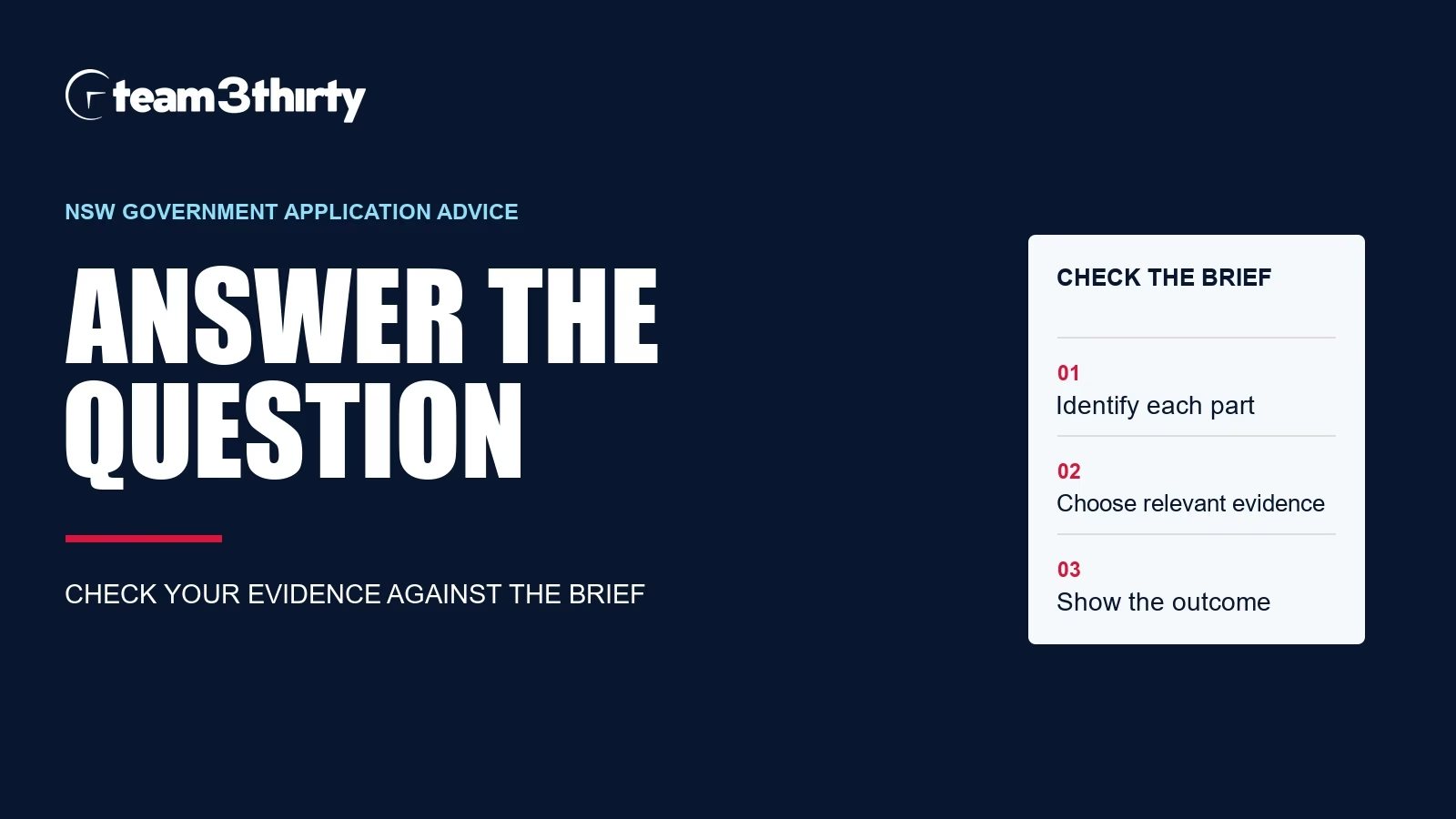
You can write a strong answer to a question the employer did not ask.
That is one of the easiest problems to miss when you are reviewing your own application. The story is relevant to your career, it contains a good result and it demonstrates something valuable. Because you know all that, it can feel like a good response.
But the question may be asking for a different piece of evidence. Analysis rather than delivery. Adaptation rather than planning. Influence rather than presentation. Your experience might contain the answer, but the version on the page does not reveal it.
Before you rewrite the whole application, check that connection. Sometimes the most useful change is not a better opening sentence. It is choosing a different example, or explaining the relevant part of the existing one.
Read the question as a brief
A targeted question usually does more than name a capability. It sets a situation, asks you to describe an action or judgement, and may request an outcome or reflection.
The capability information helps you understand the performance expected. The question tells you which evidence to provide in this response. Official interview-design guidance likewise emphasises clear questions grounded in the role and relevant behaviour. [1]
I would underline the important verbs and conditions before drafting. Did the employer ask you to analyse conflicting information? Gain agreement? Respond to changing priorities? Explain a difficult decision? What made the requested situation distinctive?
Then I would identify any second part. How did you know the approach worked? What did you learn? What would you do differently? An otherwise good answer can lose its focus by treating those parts as optional.
A worked example: the question is about influence, not just analysis
Consider this invented question for illustration: “Describe a time you used evidence to influence a decision when stakeholders held different views. What did you do, and what was the outcome?”
An applicant chooses a reporting project. Their draft explains how they cleaned the data, checked the calculations and produced a clear dashboard. It finishes by saying the dashboard was delivered on time.
There may be useful analytical evidence here. But several parts of the actual question remain unanswered. What decision was being made? Which views differed? How did the applicant use the evidence to influence anyone? Did the decision change?
The answer is not fixed by adding a final sentence that says, “This demonstrated my influencing skills.” The missing material is substantive.
Two ways to repair that answer
The first possibility is that the chosen example contains the relevant evidence but the draft has omitted it. Perhaps operations wanted one reporting measure and finance wanted another. The applicant’s analysis revealed that the measures answered different questions, and they recommended a combined approach that clarified the decision.
If that is what actually happened, the revised answer should explain the disagreement, the analysis, how the applicant presented the implications and what the decision-maker did. The dashboard becomes part of the story rather than its entire purpose.
The second possibility is that the applicant did not influence a decision in that situation. They completed the analytical task, but someone else handled the disagreement. In that case, the answer should not be embellished. Choose a different example or accurately explain the contribution without pretending it meets a requirement it does not.
These are hypothetical possibilities. The right repair depends on the facts of your experience.
Duties can answer a different question from the one intended
A description of duties answers, “What was part of your job?” A capability example often needs to answer, “How did you handle this kind of situation?”
If asked about competing priorities, a list of responsibilities may establish that you were busy. It does not explain how you prioritised. If asked about customer needs, a description of a service may establish context. It does not show how you understood or responded to a particular need.
The official preparation tool encourages specific examples, including your own actions and the outcome. [2]
That is why the move from responsibility to evidence is so important. You do not need to abandon the role description on your CV. You need to add an example that shows performance within it.
The wrong capability level can create the same problem
Sometimes the answer addresses the topic but not the scope required. You have explained a genuine decision, but it does not demonstrate the level of complexity or responsibility the role needs.
The framework’s levels describe increasing complexity and skill. The actual vacancy may require a mix of levels, not one level associated with its grade. [3] [4]
Read the example for what it establishes. Did you make the decision or carry out an instruction? Did you consider alternatives or apply a known procedure? Did you influence one immediate interaction or a broader approach? Neither end is inherently better; the relevant level depends on the role.
Again, do not fix a mismatch with adjectives. If the work involved more responsibility than the draft shows, explain it. If it did not, another example may be necessary.
A work task asks you to do the work, not describe a previous occasion
This distinction becomes particularly important in assessment exercises. An instruction to prepare a brief from supplied information is different from a question asking about a brief you wrote in the past.
In the first case, a STAR story can be the wrong response even if it is an excellent story. The task may require analysis, a recommendation, a clear structure and attention to the supplied constraints. The recruitment guide describes work samples as one of the established assessment methods. [1]
Read the requested output carefully. Who is the audience? What decision or purpose should the output support? What information can you use? What limits apply? What is due, and when?
A personal example can occasionally support a response if the task allows it. It should not displace the work you have actually been asked to produce.
Check whether your answer has drifted towards what feels safest
Applicants naturally prefer material they know well. You may have a polished project example, a familiar leadership story or a CV paragraph you have used many times.
The risk is that the answer quietly follows the prepared material instead of the question. You spend more space on the part you can explain confidently and less on the part the employer is trying to explore.
A useful review is to label the function of each paragraph. Context. My responsibility. Analysis. Influence. Outcome. Reflection. Do those functions match the question, or does the answer spend most of its space somewhere else?
This is a private editing exercise, not a requirement to put those labels in the final application. It helps expose the imbalance.
Ask a reader to find the answer
Give someone the question and the response without explaining the story first. Ask them which sentences answer each part.
If you need to interrupt with “what I meant was”, you have found something the application needs to make clearer. The panel will not have the benefit of your explanation sitting beside the document.
A reader unfamiliar with your workplace can be particularly useful. They will notice acronyms, missing context and assumptions that a colleague might fill in automatically.
Their task is not simply to say whether the writing sounds professional. It is to identify whether the evidence answers the brief.
Do not make the answer broader to make it safer
When unsure, an applicant may add more material: another capability, another achievement, another statement of strengths. But breadth can hide the missing answer rather than repair it.
Behavioural indicators are illustrative and not every indicator applies to every role. There is no need to turn a targeted response into a compressed summary of the whole framework. [5]
Choose the evidence that answers the question, explain it at the required level and remove material that distracts from that purpose. A focused response can be more useful than one that tries to demonstrate everything at once.
Before submitting, ask one final question: what can the reader conclude from the evidence actually on this page? Not what you hoped to show, and not what you know from the experience. What have you made visible?
That is the question an application review should help you answer. Team 3Thirty can check the vacancy and your responses together, so improvements address the brief rather than only the wording.
Sources and further reading
- NSW Government: Recruitment and Selection Guide (2025 edition; especially sections 3.2, 3.3 and 5)
- OPSC: Capability Application Tool and preparation advice
- OPSC: NSW Public Sector Capability Framework
- NSW Public Service Commission: Capability Comparison Guide
- OPSC: Factsheet for the revised NSW Public Sector Capability Framework
For a dated example of how application instructions vary, see Team 3Thirty’s analysis of 2,698 adverts returned by iWorkForNSW on 6 October 2026. The figures describe wording in captured adverts, with their denominators and source limits.