
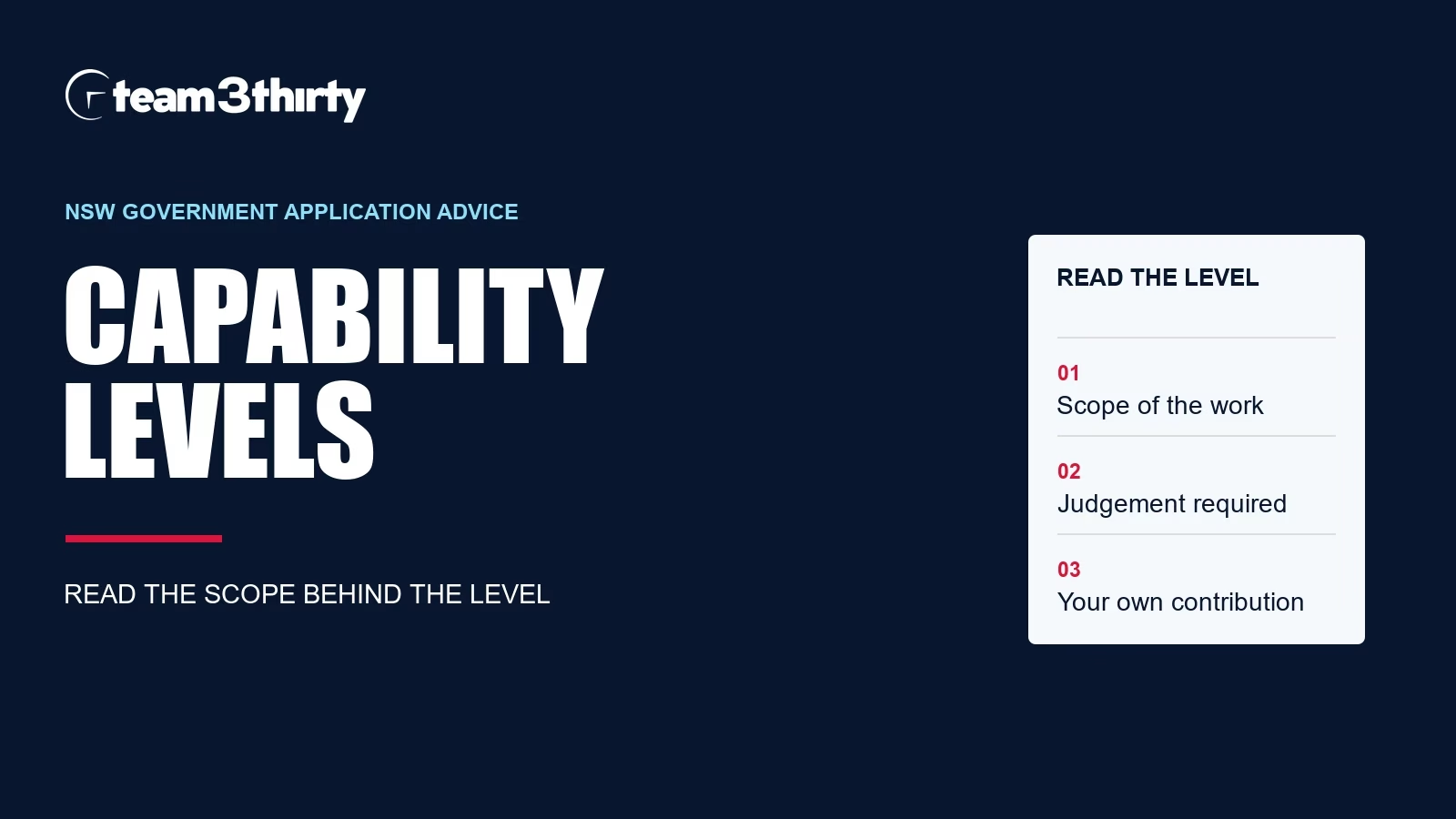
You recognise the capability. You communicate, solve problems, work with stakeholders and deliver results in your current job. The difficult part is the word beside it: Adept. Or Advanced. What makes your example one rather than the other?
It is tempting to look for a simple conversion chart between years of experience, salary, job title and capability level. That would make applications easier. It would also hide the part that matters: what the role requires you to do, and at what degree of complexity.
The NSW framework’s five levels describe increasing complexity and skill. They are not five certificates you collect, and they are not a single label permanently attached to you as a person. A role can require different capabilities at different levels. [1] [2]
My practical advice is to stop asking, “Am I an Advanced person?” and ask, “Does this example show the level of performance required for this capability in this role?”
The same capability can describe very different work
Take problem-solving. At one end, you might recognise an error, follow an established process and know when to seek help. At another, you might make sense of an ambiguous problem affecting several functions, decide between imperfect options and establish an approach others will use.
Both involve solving problems. They differ in scope, uncertainty, responsibility and impact. Those are useful questions to ask when interpreting the levels, but they are not a substitute for the official indicators for the particular capability.
A senior-sounding outcome can conceal a small contribution. A modest-sounding job can contain substantial judgement. The application needs enough detail for the reader to understand the difference.
For example, saying you “supported a statewide program” establishes context. It does not tell the reader whether you booked meetings, coordinated a difficult delivery stream or determined the program’s approach. None of those contributions should be misrepresented; they simply provide different evidence.
An illustration of the five levels
The following example is an interpretation to help you think, not official wording or a scoring guide. Imagine the same broad problem: people using a service are experiencing avoidable delays.
At a Foundational level, useful evidence might show that you recognised a routine issue, checked the relevant instructions, acted within your responsibility and raised something you could not resolve. Good performance includes knowing the limits of your authority. It does not require pretending you redesigned the whole service.
At an Intermediate level, the example might involve investigating a recurring issue within your work area, gathering relevant information and recommending a practical response. The reader would need to see more than recognition: how did you establish what was happening and decide what to do next?
At an Adept level, the example might require analysing information from several sources, working through competing explanations and selecting an approach that addresses a more complex problem. It may involve navigating dependencies or balancing the needs of different groups.
At an Advanced level, the problem might extend across functions or reveal a systemic weakness. Your contribution may involve bringing together evidence and expertise, challenging assumptions and establishing a response with broader organisational consequences.
At a Highly Advanced level, the evidence might concern organisational direction, the conditions needed for sustained improvement or approaches to complex issues that affect the organisation at a strategic level.
The precise progression differs by capability. Do not take this illustration into an application as though it overrides the published indicators. Use it to notice whether your evidence describes the required degree of judgement and responsibility.
Why Grade 7/8 does not simply mean Adept
The official Capability Comparison Guide suggests distributions of capability levels across grades. It is not a one-grade, one-level equivalence table. It was developed to support role design, with particular grade and executive-band contexts, and provides a starting point rather than a universal personal ranking. [2]
A vacancy may therefore require a mix. You could be expected to demonstrate a relatively demanding level in a capability central to the role while another capability is required at a lower level. The role description is the place to establish that mix.
This is especially important for private-sector applicants. A commercial title such as manager, lead or consultant does not translate automatically into a NSW grade. The title may reflect people management, technical expertise, client responsibility or an organisation’s naming conventions. You need to compare the actual work.
The reverse is also true. An applicant should not rule themselves out merely because their current title sounds junior. Look at responsibility, complexity and evidence before drawing that conclusion.
Years of experience help only when you explain what they contain
Fifteen years can include deepening expertise, increasing responsibility and varied problems. It can also include many years doing work at broadly the same scope. Neither description is a judgement about the person’s worth. The recruitment question is narrower: what does that experience demonstrate for this role?
Instead of relying on tenure, explain a relevant piece of work. What could you decide? What needed approval? Who depended on your advice? What uncertainty did you handle? What changed because of your contribution?
An illustrative weak statement is, “I have extensive experience managing complex stakeholders.” A more useful account would identify the parties’ competing needs, the consequences of disagreement, the approach you chose and the agreement or next step you secured. The stronger account lets the reader examine the claimed complexity instead of being asked to accept the adjective.
The level is often hidden in the action section
Applicants can spend so much time describing the scale of the organisation that they leave little room for their own decisions. An answer about a large project can still read as low-level evidence if the only personal actions described are attending meetings and sending updates.
To strengthen the evidence, do not inflate your role. Recover the details you have omitted. Did you identify an inconsistency? Evaluate options? Recognise a risk others had missed? Decide who needed to be involved? Change an approach when the evidence did not support it? Explain why those actions mattered.
The result is important, but it does not do all the work. An impressive team outcome is not proof that you personally demonstrated every capability at a high level. Equally, a project that did not achieve its original objective may still contain useful evidence of judgement, provided you explain the circumstances, your actions and the outcome honestly.
Higher level does not always mean more staff or a larger budget
Some examples become more complex through the number of people or amount of money involved. Others become more complex through uncertainty, sensitivity, competing obligations or the quality of judgement required. A budget figure is context, not an automatic capability score.
This matters for specialists and individual contributors. You may influence a consequential decision without managing a large team. You may also manage several people in an established process without having organisation-wide strategic responsibility.
Read the actual capability. Manage and Develop People naturally concerns people-management practice. A capability such as Think and Solve Problems or Communicate Effectively may be demonstrated through a different form of responsibility. Do not assume one type of seniority proves every other type.
How to test an example before writing it
I would write a rough, unpolished account of the example and then ask three questions. First, is the situation relevant to this role? Second, can a reader identify the decisions and actions that were mine? Third, does the evidence show the complexity described at the required level?
When the answer to the third question is unclear, I would revisit the official indicators and the role’s accountabilities. Sometimes the example is appropriate but under-explained. Sometimes it is genuinely too narrow, and another example is needed. Adding adjectives such as strategic, complex and high-level will not resolve that difference.
It can also help to have someone challenge the example. Ask them to explain back what they think you did and why it was difficult. If their understanding is much smaller than the work actually was, your draft has left important evidence out.
What the 2026 revision changes about levels
The five level names have not changed. Some behavioural detail has, including contemporary expectations about digital work, customers, cultural capability and leadership. [3]
You should therefore check the current wording rather than relying entirely on an old interpretation. But you do not need to promote every example to a higher level because the calendar changed. The task remains matching evidence to the specific requirement.
A useful application is not the one that claims the highest possible capability level. It is the one that gives a credible account of the right capability at the level the job needs.
Unsure whether a role is the right level? Team 3Thirty can help compare its accountabilities and capability requirements with your experience. That is a more useful starting point than matching job titles or choosing a grade from salary alone.