
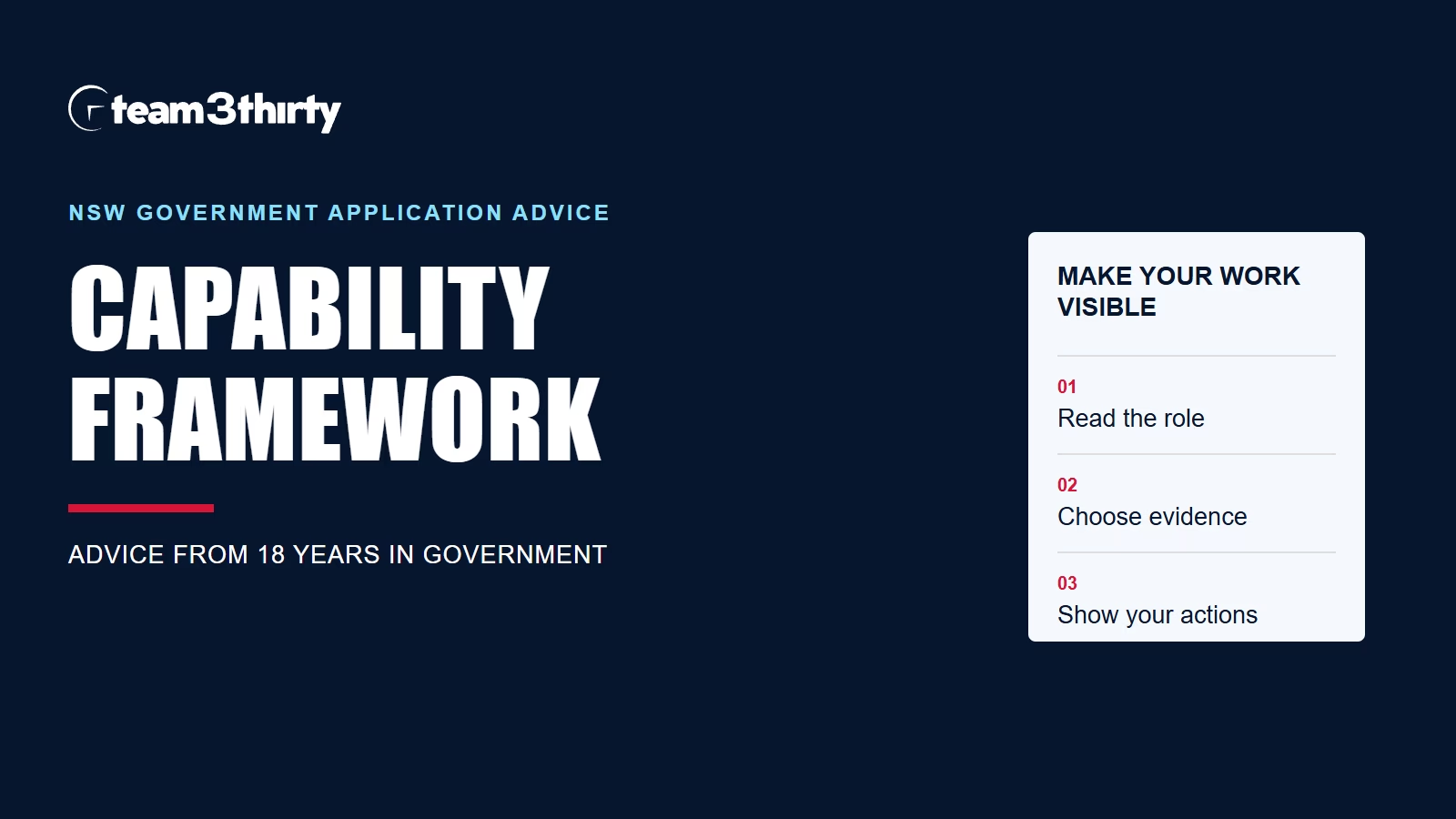
I spent 18 years working in government. When I help someone make sense of a government application now, I am conscious of how much can look obvious from the inside and confusing from the outside.
A role description can appear to give you everything: the responsibilities, the capabilities, the levels and the questions. But being given the information is not the same as being shown how to use it. You can read every page and still be unsure what belongs in your application.
The way I think about Team 3Thirty is personal. I was the mate you went to when you wanted help with an application. Now, that is the kind of help I want to make available to people who do not already have someone inside government to ask.
Here is the practical advice I would give you about the Capability Framework before you spend another evening trying to sound like the role description. If you need the full explanation of its structure and levels, start with our Capability Framework guide. Here, I want to focus on the decisions that make an application useful.
First, the framework is not the job
You need to understand the work before you can decide which evidence matters. What is this person there to achieve? Who will they work with? What makes the role difficult? What decisions will they make, and what will they need to refer to someone else?
The Capability Framework helps describe the knowledge, skills and abilities needed to do that work. It also supports things beyond recruitment, including development, performance and workforce planning. It was not designed solely as a list of sentences for candidates to reproduce. [1] [2]
That is why I would not begin an application by copying the capability table into a blank document. I would begin by understanding the role. The table then helps me interpret the type and level of performance required.
Otherwise, you can produce a technically tidy answer about a capability without making a convincing case for the actual job.
Knowing you can do it is different from showing someone else
You know the history behind your CV. You know which jobs were difficult, which projects were messy and which outcomes took considerable effort. The reader does not.
A statement that you managed stakeholders might represent years of careful relationship work. On the page, it can still look like a generic claim. You need to choose a situation and explain enough of it for someone else to understand your contribution.
What was the issue? What were you responsible for? What did you do that required judgement? What happened because of that action?
I would rather read a clear account of one relevant piece of work than a paragraph filled with claims that someone is strategic, collaborative, resilient and results-driven. The first gives me something to examine. The second asks me to accept the applicant’s description of themselves.
The level beside the capability deserves more attention
Two applicants can both have experience solving problems and still provide quite different evidence. One may have resolved routine issues within an established process. Another may have worked through uncertainty across several functions and recommended a broader change.
The framework’s levels describe increasing complexity and skill. The official comparison guide is not a simple equation between a grade and one capability level. [1] [3]
So I would not ask only whether you have an example of communication or problem-solving. I would ask whether the example demonstrates the kind of responsibility this role needs.
This matters for experienced people. A long career does not explain itself. You still need to show the scope of the work, your authority, the difficulty of the decision and your contribution. Equally, an ordinary-sounding title does not automatically mean your evidence is too small. Look underneath it.
Focus capabilities are a guide to preparation, not permission to ignore the role
Focus capabilities deserve deliberate attention because of their role in recruitment assessment. Complementary capabilities may also be assessed, and the process still needs to consider other relevant requirements. [4]
I would use the focus capabilities to decide where to prepare strong examples. I would not use them as a reason to ignore essential requirements, professional knowledge or the actual question on the application form.
A candidate can write an excellent capability response and still leave the employer uncertain about something fundamental to the vacancy. Have you worked with the relevant kind of information? Do you hold the required qualification? Do you understand the practical purpose of the role? Those questions are not answered simply by repeating a capability heading.
Good preparation holds the whole role in view while giving the important assessment areas the attention they deserve.
You do not need thirty miniature examples
The behavioural indicators can make the application feel larger than it is. OPSC is explicit that they are illustrative, not exhaustive, and not every indicator applies to every role. [5]
My advice is to select evidence with enough substance to answer the question. Then use the indicators to check whether you are showing the relevant behaviour and level.
Consider an illustrative reporting example. Several teams used different definitions for the same measure. You compared the source records, checked the definitions with the people responsible and recommended one reporting rule. Explain what you checked, why you chose that approach and how the agreed rule was used. Depending on the question, emphasise the analysis, the communication or the decision.
You would not need to bolt on a sentence about every other capability just to make the example look comprehensive. More labels do not necessarily create more evidence. Sometimes they simply use the space you needed to explain the important decision.
Clear writing is not less professional
There is a particular kind of application writing that seems designed to conceal what happened. Ordinary actions become “the facilitation of strategic alignment”. Talking to two teams becomes “leveraging cross-functional stakeholder synergies”.
I do not think you need that language to demonstrate capability. You need accurate terms where they matter, but the reader should be able to understand your actions on the first read.
Compare the illustrative phrases “facilitated cross-functional alignment” and “brought the operations and finance teams together to agree how exceptions would be handled”. The second explains the work. It also gives the reader a basis for asking a useful follow-up question.
The official preparation tool encourages relevant capability language and specific examples of your own actions. Connect the wording to what you did. [6] Our STAR method guide shows how to organise that explanation without losing the detail.
The 2026 update changes the detail, not the need for evidence
NSW revised the framework in January 2026, with a transition deadline for agency systems and role descriptions of 29 January 2027. The underlying structure remains, while behavioural expectations have been updated. [7]
For me, the practical response is to read the relevant detail again. Digital judgement, customer experience, cultural capability and other updated themes may help you identify evidence you previously overlooked. They are not an invitation to invent a new career history.
Perhaps a project involved testing whether an apparent improvement created a barrier for some users. Perhaps you checked data before it informed advice. Perhaps you sought expertise because the team did not have the knowledge it needed. Explain those things where they are relevant.
Do not add AI to every answer. Do not claim cultural expertise you do not have. And do not assume an old example is unusable simply because the framework has changed.
When the application does not progress
This is important when you have been applying for a while. A rejection gives you an outcome, but it does not always give you a diagnosis.
You may have chosen a role that was not the right fit. You may have left important evidence unclear. Other candidates may have demonstrated a stronger match. Without useful feedback, you should be cautious about deciding which explanation applies.
I would review the process before rewriting your entire professional identity. Look at the roles you are choosing, the levels required, the questions asked and the evidence you have provided. Find the specific gap you can act on.
A better application cannot guarantee an interview. It can make your case clearer and reduce avoidable uncertainty about what you bring.
What I would tell a mate before they press submit
Make sure you have answered the actual questions. Check that the reader can see what you personally did. Choose examples that fit the role and level, not just examples you are proud of. Follow the format. Keep the language clear. Do not claim anything you would struggle to explain at interview.
That is the advice I would want you to take from my 18 years in government. You do not need to become an expert in every page of the framework. You do need to understand how to use it to make your relevant experience visible.
Before you open your next draft, write down the role’s main demands and one example you can explain clearly for each. If you want help turning that evidence into the required documents, request a Complete Government Application. We build it around the actual vacancy and your real experience.
Official sources and further reading
- OPSC : NSW Public Sector Capability Framework
- OPSC : How to apply the Capability Framework
- NSW Public Service Commission : Capability Comparison Guide
- NSW Government : Recruitment and Selection Guide (2025 edition; especially sections 3.2, 3.3 and 5)
- OPSC : Factsheet for the revised NSW Public Sector Capability Framework
- OPSC : Capability Application Tool and preparation advice
- Office of the Public Service Commissioner : OPSCC-2026-01 (19 January 2026)