
Infrastructure is where the NSW Budget turns into real-world delivery. It is also where many public sector roles sit, even when they do not look like construction jobs from the outside. A hospital redevelopment needs project governance. A rail maintenance program needs scheduling, procurement, asset data and customer communication. A social housing program needs land, contracts, tenant interfaces, reporting and risk control. A renewable energy zone needs approvals, community engagement, land acquisition, biodiversity work and commercial management.
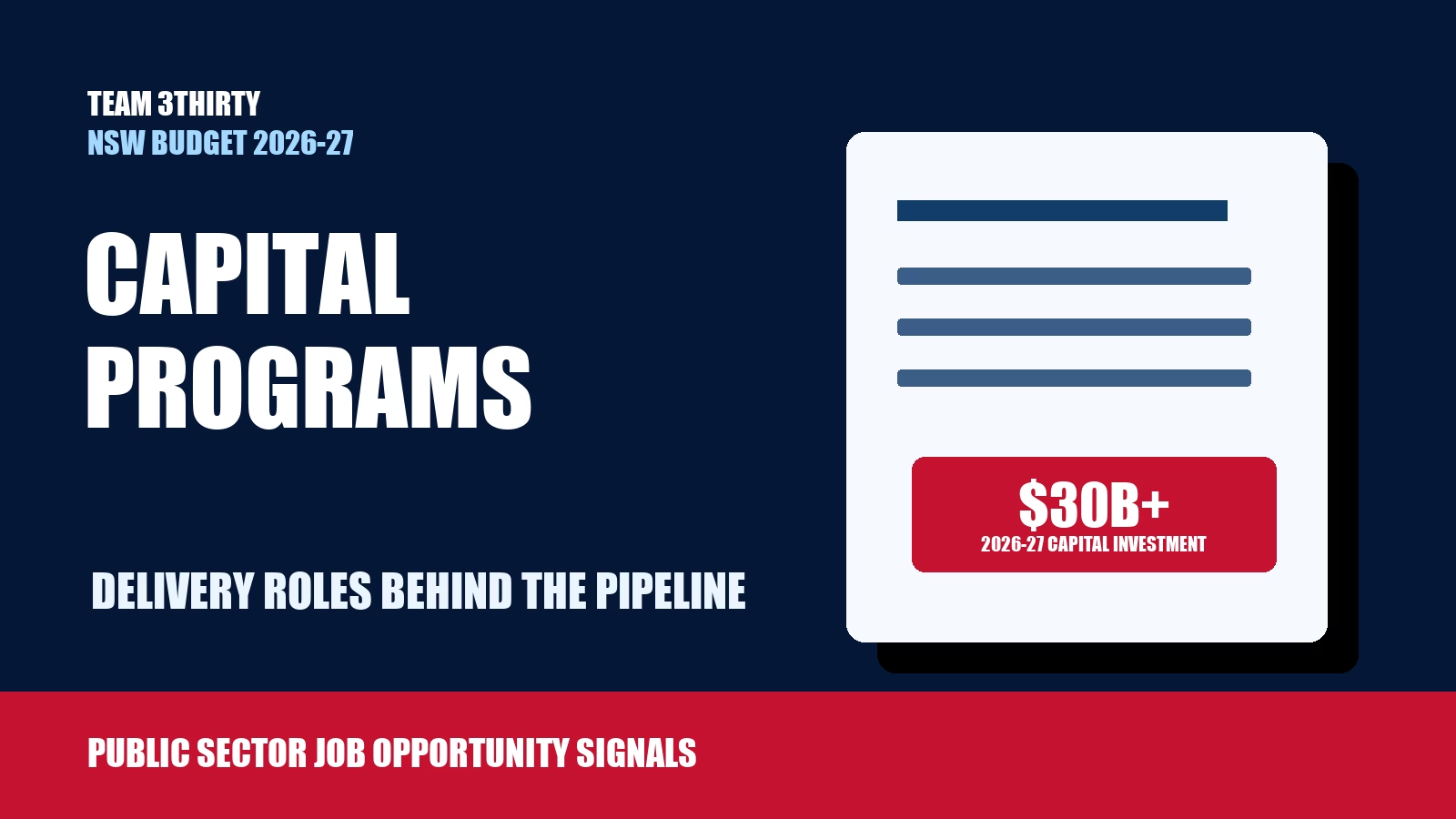
That is why the 2026-27 NSW Budget infrastructure program matters for public sector job seekers and existing public servants. Budget Paper No. 3 sets out a $116.7 billion infrastructure program over the four years to 2029-30. Investment is expected to exceed $30 billion in 2026-27, which the Budget describes as an average of $82.7 million a day. This is not background noise. It is one of the main ways the State is trying to respond to service demand, growth, housing pressure, network reliability and long-term productivity.
The best way to read the infrastructure program is by agency and portfolio. The largest agency capital increase is Transport for NSW, up $1.4 billion from the 2025-26 revised figure to the 2026-27 Budget. EnergyCo rises by $564.2 million, Health by $375.6 million, DCJ by $341.0 million, DCCEEW by $293.7 million and Education by $168.1 million. Western Parkland City Authority also rises sharply, up $152.0 million. These are the agencies carrying the biggest new delivery weight.
Transport, health and education dominate the visible pipeline
Transport is the largest capital story. Budget Paper No. 3 lists $60.2 billion for public transport, roads and infrastructure over four years. It includes $4.5 billion for Metro expansion in 2026-27, $2.4 billion in new investment for Parramatta Light Rail Stage 2, $6.6 billion over four years for Western Sydney roads, and record annual heavy rail maintenance of $2.1 billion for signalling systems, maintenance and station upgrades. It also includes major continuing programs such as Sydney Metro West, Sydney Metro Western Sydney Airport, road safety investment, Princes Highway works, Coffs Harbour Bypass, Pacific Motorway extension to Raymond Terrace, and the New Electric Bus Program.
For the job market, that creates a broad surface. Transport needs engineers and planners, but also project officers, schedulers, commercial staff, procurement people, risk advisers, safety specialists, customer communications, stakeholder teams, data analysts, asset managers and PMO staff. It also needs people who understand live operations. A transport network is not a blank construction site. It is a public system already carrying passengers, freight, complaints, delays, incidents and political scrutiny.
Health is the next major infrastructure signal. The Budget includes $11.9 billion over four years for health infrastructure, and Ministry of Health capital expenditure rises by $375.6 million in 2026-27 against the revised 2025-26 figure. Major programs include a $400.0 million Health Asset and Equipment Renewal Program, the $2.0 billion Bankstown Hospital, $910.0 million Rouse Hill Hospital, $940.0 million Royal Prince Alfred Hospital redevelopment, $880.0 million Liverpool Health and Academic Precinct, $828.9 million New Shellharbour Hospital and Integrated Services, $615.5 million NSW Ambulance Infrastructure Program, Statewide Mental Health Infrastructure Program, Single Digital Patient Record, NSW Health Pathology infrastructure and regional hospital redevelopments.
Education is also significant, even though the workforce story is more nuanced. Budget Paper No. 3 identifies $9.2 billion over four years to support more than 260 new and upgraded schools, more than 1,400 new classrooms and 18 new schools expected to open in 2026-27. It also lists the 100 new government preschools program, new schools in growth areas, the High Potential and Gifted Education Partner School Program, NESA technology reform and TAFE NSW Manufacturing Centres of Excellence. Education capital work creates demand for planning, school operations, asset strategy, project coordination, community consultation, procurement, technology reform and regional delivery.
Energy, housing, justice and public safety are the less generic opportunity zones
EnergyCo and DCCEEW are two of the strongest delivery signals in the Budget. EnergyCo capital expenditure rises by $564.2 million, and DCCEEW capital rises by $293.7 million. Named programs include the Transmission Acceleration Facility, Central West Orana Renewable Energy Zone, South West Renewable Energy Zone Network Infrastructure Project, Newcastle Port Logistics Precinct, National Parks Visitor Infrastructure Management, Strategic Fire Trails Network, Sustainable Diversion Limit Adjustment Mechanism Acceleration, Northern Basin Toolkit and Nyngan to Cobar Pipeline and Pumping Stations.
This is where the public sector job story becomes more interesting than "engineers and builders". Energy and environment programs need land acquisition, biodiversity offsets, environmental assessment, approvals, procurement, regional stakeholder engagement, grants, community benefit work, contract management, data, regulation and ministerial reporting. A person with experience in planning, environment, utilities, local government, agriculture, property, consultation or project coordination may have a stronger angle than they realise.
Communities and Justice is another major capital story. DCJ capital expenditure rises by $341.0 million. Its project list includes building new social housing supply with a $1.08 billion 2026-27 allocation, Aboriginal Children and Family Centre Program, Intensive Therapeutic Care Asset Strategy, Sydney CBD Courts and Vulnerable Persons Hub, Rebuilding the NSW Industrial Relations System, Regional Key Worker Housing, Sustaining Critical Infrastructure Program Phase 3 and youth justice facility upgrades. This is infrastructure tied closely to social policy, justice, housing and vulnerable cohorts.
Public safety and communications also stand out. NSW Police capital expenditure rises by $45.9 million, with programs including the Armed Response Command, Policing Technology Program, regional station upgrades, integrated connected officer work, cyber security, enterprise resource planning and firearms registry capability. The Government Telecommunications Authority has a capital increase of $38.8 million, with programs such as the Public Safety Network and Critical Communications Enhancement Program. These are useful signals for people with technology, communications, emergency management, fleet, facilities and operational support backgrounds.
How to turn capital spending into a job-market read
The mistake is to read capital spending as only bricks, concrete and tracks. In government, capital spending also creates a large administrative, commercial and governance environment. Projects need people who can prepare briefs, manage contracts, coordinate vendors, maintain registers, track budgets, handle procurement, monitor risks, support governance forums, respond to stakeholders, manage correspondence, report progress and translate technical work into decisions.
That is why infrastructure and capital posts are useful for applicants from outside government. If you have worked in construction administration, consulting, local government, utilities, property, health operations, education infrastructure, transport, community services, ICT, finance or procurement, you may already have relevant evidence. The missing piece is usually translation. Your application has to show why that experience helps a NSW Government team deliver public work under scrutiny.
For existing public servants, the infrastructure program is also a mobility map. If you want to move into higher-complexity work, look at agencies with large programs and ask where your current skills fit. Policy officers can move closer to delivery. Administrative staff can build evidence around reporting and coordination. Communications staff can move into infrastructure engagement. Finance staff can move into project controls. Procurement staff can build a case around value-for-money and probity.
The Budget will not tell you which specific role will open next. But it does show where the State has committed to work that must be planned, delivered, explained and governed. That is where infrastructure becomes more than a capital table. It becomes a map of capability demand.
Sources include the NSW Budget 2026-27 Budget Papers, Budget Paper No. 3 Infrastructure Statement, Budget Paper No. 4 Agency Financial Statements, and the NSW Budget open data. For the broader series, start with what the NSW Budget really signals about public sector jobs, agencies and major programs.