
If you’re applying for the Project Officer Biodiversity Indicator Program role with the NSW Department of Climate Change, Energy, the Environment and Water, it’s important to understand exactly what this recruitment is looking for and how to structure a competitive application.
This guide breaks down the NSW Government application requirements for this role, shows you how to interpret the candidate requirements in the job ad and gives you a practical structure for a high quality, two page cover letter. If you want to move quickly and get it right the first time, download our free NSW Government cover letter template.
Once you have your documents ready, you can apply here: Apply for the Project Officer role.
Table of Contents
| Role Title: | Project Officer – Biodiversity Indicator Program |
| Organisation / Entity: | Strategic Policy Science & Engagement |
| Job location: | Parramatta other NSW Locations considered upon application, hybrid working supported |
| Job reference number: | 546392 |
| Work type: | Full-Time |
| Total remuneration package: | From AUD from $109,102 to $120,542 + super |
| Closing date: | 07/12/2025 – 11:55 PM |
NSW Government Application Requirements
When applying for a NSW Government role, it is essential to follow the application instructions exactly as they appear in the job ad. Each department sets its own requirements, and these outline precisely which documents you must submit, such as a CV, cover letter or responses to selection criteria. They also prescribe the formatting rules, including file type, page limits or word counts.
These requirements are not suggestions. Even well qualified applicants will be screened out if they submit incomplete documents or fail to meet the formatting rules. The first stage of the recruitment process is compliance checking, so accuracy matters.
Application requirements for Project Officer – Biodiversity Indicator Program

For this role, you must provide:
- a cover letter
- a copy of your resume
Your cover letter must be tailored to this specific role, and you will need to use the language from the job ad, and give clear and directly relevant examples.
Your CV or Resume should be tailored to government applications, but does not have to be tailored for every specific role. It should, as much as possible, align with the range of government jobs you are applying for using that CV.
In this recruitment, your cover letter is going to be the key document that determines if you land an interview or not. There is no cover letter page limit here, so I recommend a two-page cover letter that is stacked with STAR method examples demonstrating how you meet the candidate requirements.
To get started quickly and in the right direction, you can download the free NSW Government cover letter template. It is the exact format I use to land interviews, and includes prompt to help you write a more effective application.
NSW Government Candidate Requirements
Every job ad also includes candidate requirements. These describe the skills, knowledge areas and experience the hiring team wants to see in your application. They tell you exactly what your documents need to address.
To be competitive, you need to give clear, specific examples that show how you meet as many of the candidate requirements as possible. Your examples should demonstrate both your technical strengths and your approach to working in a government context.
Candidate requirements for Project Officer – Biodiversity Indicator Program
In this role, the candidate requirements appear in the “About You” section of the job ad. When requirements are clearly listed in the ad, your cover letter must align with them closely. The hiring manager wrote these to guide applicants, so they reflect what will actually be assessed when your application is reviewed.
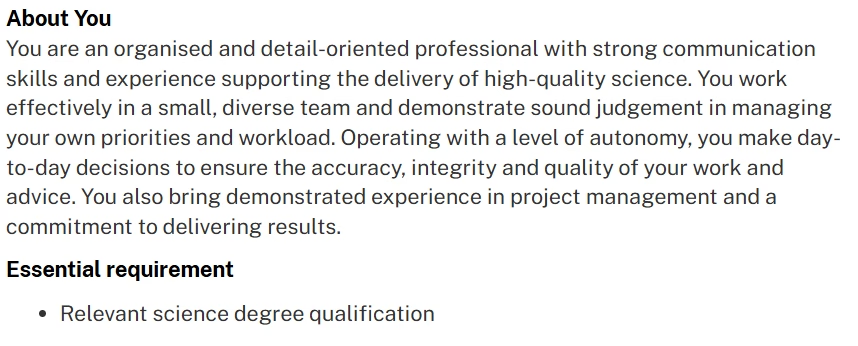
When candidate requirements are detailed in the job ad, make sure you align your cover letter to these. The hiring manager took the time to write these specifically for this recruitment. It outlines exactly what they are looking for when they review your application.
For this job ad, break down the About You section into a clear list. Here is how the “About You” section for this role breaks down into a practical checklist:
- organised and detail-oriented
- strong communication skills
- experience supporting the delivery of high quality science
- ability to work effectively in a small and diverse team
- sound judgement in managing priorities and workload, with the ability to operate with autonomy
- capacity to make day-to-day decisions that ensure accuracy, integrity and quality of work and advice
- demonstrated project management experience and a commitment to delivering results
- relevant science degree qualification
For each requirement, include one clear paragraph with a real example that demonstrates your capability. This approach creates a structured, targeted two page cover letter that directly aligns with what the hiring manager is looking for.
Your paragraphs should focus on:
- what the situation was
- the actions you took
- the results you delivered
- how the example links to the requirement
This format makes it easy for assessors to see that you meet the expectations for the role.
Example Two Page Cover Letter: Project Officer – Biodiversity Indicator Program
Below is an example cover letter written for this role. It features a fictional candidate with relevant experience from the private sector. The example shows how to transform the candidate requirements into clear, evidence-based paragraphs that fit within a two page structure.
If you would like support with your own cover letter, you can get tailored advice from a hiring manager through Application Writing Support.
Dear Hiring Manager,
I’m excited to apply for the Project Officer role within the Science & Insights team. My background across the resources sector and consulting has given me strong experience coordinating complex technical work, supporting scientific teams and contributing to evidence-based projects for government clients. I’m drawn to this role because it combines structured project coordination with meaningful environmental science, and I’m motivated by the opportunity to contribute to high-quality biodiversity indicator reporting.
I have extensive experience being organised and detail-oriented when managing technical workstreams. For example, as a Project Coordinator with GreenRange Resources, I was responsible for tracking more than a dozen environmental deliverables across specialist hydrology, ecology and modelling teams. I maintained structured schedules, implemented version control protocols across shared documents and monitored progress to ensure dependencies stayed aligned. When timeframes shifted, I updated stakeholders quickly and prevented minor delays from affecting downstream tasks. By keeping the detail tight and reducing data inconsistencies, I enabled technical experts to focus on analysis while ensuring the project met all milestone commitments.
I will bring strong communication skills that support clear and constructive engagement across diverse audiences. In one instance, while consulting with the Australian Energy Analysis Office, I coordinated weekly discussions between internal modellers and APS policy officers working on climate-related scenarios. I prepared concise status briefs, clarified expectations when requirements changed and translated technical assumptions into plain English for executives. When concerns arose, I initiated short, solutions-focused conversations to avoid misunderstandings. This approach kept communication open, supported smooth decision-making and strengthened confidence in the project’s progress.
I also have experience supporting the delivery of high-quality science by ensuring technical inputs are well organised, accurate and clearly presented. This was demonstrated when I coordinated specialist environmental datasets for a major baseline assessment led by our internal science team. My role involved collecting input from field researchers, checking it against project requirements and resolving inconsistencies directly with subject-matter experts. I verified data sources, documented assumptions and ensured the technical narrative in draft outputs reflected the intent of the scientists involved. This structured support contributed to a scientifically sound final report that was well received by both internal leads and the client agency.
I work effectively in small, diverse teams, where collaboration and respectful communication are essential. For example, during a consulting engagement combining environmental scientists, economists and policy analysts, I supported day-to-day coordination and helped maintain a positive working rhythm. I created simple shared tools to make collaboration easier and facilitated conversations when competing perspectives needed alignment. The openness and trust we built allowed us to progress efficiently despite differing backgrounds and working styles, and the client commended our cohesive approach.
I demonstrate sound judgement in managing priorities and operating autonomously when projects are busy or expectations shift. In one instance, while supporting a climate policy project for the National Climate Adaptation Unit, I balanced multiple workstreams involving stakeholder engagement, document drafting and internal review cycles. I assessed which tasks had the greatest impact, planned my work accordingly and escalated only when senior input was genuinely needed. When unexpected requests arrived, I adjusted my schedule while keeping core deadlines secure. This independent, measured approach ensured the project stayed on track and gave senior consultants confidence in my reliability.
I make day-to-day decisions that protect the accuracy, integrity and quality of project outputs. While coordinating technical analyses at GreenRange Resources, I regularly identified inconsistencies between draft datasets and supporting assumptions. Rather than passing issues downstream, I verified information with the originating specialists and corrected errors early. These routine quality decisions prevented rework and significantly improved the reliability of final deliverables. Stakeholders came to value the precision and consistency of the materials I prepared.
I have strong project management capability and a clear commitment to delivering results. This was evident when I coordinated a multi-stream program involving external consultants, senior executives and several internal science and policy teams. I developed the delivery schedule, tracked risks, coordinated contributor inputs and maintained consistent communication to keep everyone aligned. When bottlenecks appeared, I proposed practical adjustments and ensured work progressed without compromising quality. The program met all agreed deadlines, and my structured coordination provided the backbone for its successful delivery.
Finally, my Bachelor of Science (Environmental Management) strengthens my ability to engage confidently with technical experts and contribute meaningfully to scientific analysis. It has supported my work across environmental, energy and climate-related projects by enabling me to interpret data, understand technical assumptions and communicate effectively with researchers and modellers. This foundation continues to inform my analytical approach and underpins the value I bring to multidisciplinary science teams.
Thank you for considering my application. I would welcome the opportunity to contribute my coordination skills, scientific grounding and collaborative approach to the Biodiversity Indicator Program. I’m genuinely motivated by the work of DCCEEW and would value the chance to support your ongoing efforts to deliver clear, evidence-based insights that strengthen biodiversity understanding across Australia.
Warm regards,
Jackie
Get your application sorted without the stress
Crafting a high quality NSW Government application takes time, structure and a clear understanding of what assessors look for. Your cover letter carries most of the weight in this recruitment, so the examples you choose and the way you present them can make the difference between landing an interview or being screened out early.
If you want to shortcut the process, get personalised guidance from a hiring manager who has assessed NSW Government applications.
You do this through Application Writing Support.
You’ll receive a personalised cover letter that uses the exact language of the job ad and positions your experience using the proven STAR method clearly against the candidate requirements. It’s the same method I use to help jobseekers secure government interviews with confidence.
If you want support with this role or any upcoming NSW Government application, Application Writing Support is the fastest and most reliable way to submit a polished, interview-ready application.